
Powerlifting Training Program PDF: A Comprehensive Guide
Powerlifting success hinges on a well-structured program, often found in PDF format, catering to beginner, intermediate, and advanced lifters. Resources like Lift Vault offer numerous free programs.
Effective programs emphasize progressive overload, adapting to individual experience levels, and incorporating key components for optimal strength gains. Careful evaluation of program quality is crucial.
Understanding Powerlifting Program Levels
Powerlifting programs are strategically tiered based on experience, typically categorized as beginner (0-6 months), intermediate (6-18 months), and advanced (18+ months). Beginner programs prioritize foundational strength and proper technique, often utilizing full-body routines with moderate volume.
Intermediate programs introduce more specialization, increasing training frequency and volume, and incorporating variations of the core lifts. Advanced programs demand a high level of commitment, employing complex periodization schemes and focusing on peaking for competition. Recognizing your current level is vital for selecting a PDF program that aligns with your capabilities and avoids plateaus or injury. Greg Nuckols highlights the importance of not prolonging a beginner program unnecessarily.
Beginner Powerlifting Programs (0-6 Months Experience)
Beginner powerlifting programs, often available as PDF downloads, focus on establishing a solid foundation. These typically involve 3-4 training days per week, emphasizing full-body workouts. Key elements include mastering proper form in the squat, bench press, and deadlift – the “big three”.
Volume is generally lower, with a focus on learning movement patterns before maximizing weight. Expect linear progression, gradually increasing weight each session. Many beginner programs utilize a simple structure, avoiding complex periodization. Resources like Lift Vault provide numerous free options. The goal is to build work capacity and neuromuscular efficiency, preparing the lifter for more intermediate training phases.
Intermediate Powerlifting Programs (6-18 Months Experience)
Intermediate powerlifting programs, frequently found as PDF guides, build upon the foundation established in beginner phases. These programs typically span 4-5 training days weekly, introducing more volume and intensity. Expect variations of the squat, bench press, and deadlift to address weaknesses and promote balanced development.
Phase 2 often focuses on building strength and refining technique (Months 4-6). Intermediate lifters may begin exploring basic periodization schemes, like linear or undulating approaches. Progressive Resistance Systems offers a 15-week intermediate program as a PDF. The aim is to increase strength efficiently while minimizing plateaus and preventing overtraining.
Advanced Powerlifting Programs (18+ Months Experience)
Advanced powerlifting programs, often delivered as detailed PDF documents, demand a high level of commitment and understanding of training principles. These programs necessitate individualized approaches, considering the lifter’s specific strengths, weaknesses, and competition goals. Expect complex periodization schemes and a significant focus on technique refinement.
Training variables within advanced programs are meticulously manipulated, incorporating intensity, volume, and frequency adjustments. Coaches often utilize autoregulation to adapt to daily readiness. While specific PDF examples are less readily available publicly, resources emphasize the importance of a strong coaching relationship and a deep understanding of powerlifting programming.
Key Components of a Powerlifting Program
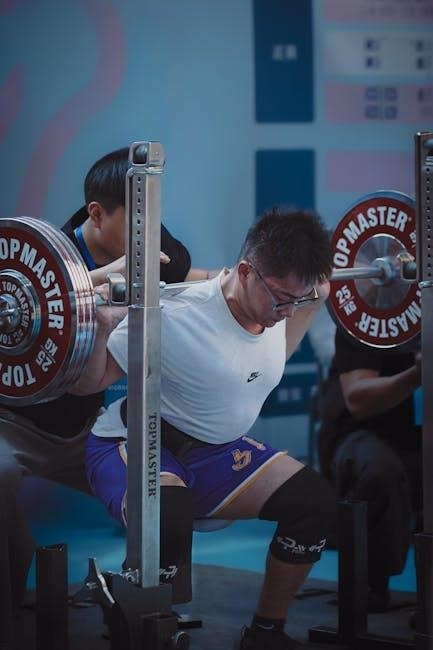
Powerlifting programs, often in PDF format, center around training frequency, volume, and intensity. Effective plans prioritize the “big three” lifts and strategic periodization.
Frequency of Training
Powerlifting program PDFs dictate training frequency based on experience level. Beginner lifters often benefit from 3-4 sessions weekly, focusing on full-body workouts to establish foundational strength and technique.
Intermediate lifters typically progress to 4-5 sessions, potentially splitting workouts to emphasize specific lifts or muscle groups. This allows for increased volume and targeted development.
Advanced athletes may train 5-6 times per week, employing complex periodization schemes and higher volumes. Recovery becomes paramount at this stage.
Regardless of level, adequate rest is crucial. A well-designed PDF program will balance training stress with sufficient recovery to prevent overtraining and maximize progress.
Volume and Intensity
Powerlifting program PDFs meticulously manage training volume and intensity. Volume, measured in total sets and reps, generally increases for intermediate lifters before potentially decreasing during peaking phases. Intensity, expressed as a percentage of one-rep max (1RM), dictates the weight lifted.
Beginner programs prioritize technique and often utilize lower intensities (60-75% 1RM) with moderate volume. As lifters progress, intensity increases, incorporating heavier weights (80-95% 1RM) for fewer repetitions.
Effective programs carefully balance these variables, recognizing that excessive volume without sufficient intensity, or vice versa, can hinder progress.
Understanding the relationship between volume, intensity, and recovery is key to utilizing a PDF program effectively.
Exercise Selection: The Big Three
Powerlifting program PDFs fundamentally revolve around mastering “the big three” – the squat, bench press, and deadlift. These movements form the core of training, with variations strategically implemented to address weaknesses and prevent plateaus.
Beginner programs often emphasize foundational technique with the standard variations. Intermediate and advanced lifters will encounter a wider range of exercises.
PDF resources detail specific squat, bench, and deadlift variations, like pause squats, incline bench, and Romanian deadlifts, to target specific muscle groups and improve overall strength.
Proper exercise selection, guided by the program, is crucial for maximizing gains and minimizing injury risk.
Squat Variations
Powerlifting program PDFs frequently incorporate diverse squat variations beyond the traditional back squat. These variations are crucial for addressing individual weaknesses and promoting well-rounded development.

Common variations include front squats, which emphasize quad strength and upright posture, and pause squats, enhancing strength at the sticking point. Box squats are utilized to improve technique and build explosive power.
Intermediate and advanced programs often include high-bar and low-bar squats, altering muscle recruitment patterns. PDF guides detail proper form for each variation, ensuring safety and effectiveness.
Strategic implementation of these variations, as outlined in the program, is key to maximizing squat performance.
Bench Press Variations
Powerlifting program PDFs recognize the bench press’s complexity, advocating for variations beyond the standard flat bench. These variations target different muscle groups and address plateaus.
Incline bench press emphasizes the upper chest, while decline bench press focuses on the lower chest. Close-grip bench press strengthens the triceps, a critical component of the bench. Pause bench press builds strength through a sticking point.
Intermediate lifters may encounter board presses, reducing the range of motion to overload specific parts of the lift. Advanced programs often incorporate chain or band work for accommodating resistance.
PDF resources detail proper technique for each, ensuring safety and maximizing gains.
Deadlift Variations
Powerlifting program PDFs highlight the deadlift’s full-body demand, recommending variations to address weaknesses and prevent stagnation. Conventional, sumo, and Romanian deadlifts (RDLs) form the core.
Deficit deadlifts, performed from a slightly elevated surface, increase the range of motion and challenge initial strength. Rack pulls, starting from blocks, target the lockout portion of the lift.
Intermediate lifters benefit from incorporating speed deadlifts to improve explosiveness. Advanced programs may utilize chain or band deadlifts for accommodating resistance.
PDF guides emphasize maintaining a neutral spine throughout all variations. Proper form is paramount to avoid injury and maximize strength gains, as detailed in comprehensive programs.

Structuring Your Powerlifting Training Plan
Powerlifting program PDFs often utilize periodization – linear or undulating – to strategically manage volume and intensity, optimizing strength gains over time.
Periodization: Phases of Training
Periodization is a cornerstone of effective powerlifting programs, often detailed within PDF guides. It involves cycling training variables to prevent plateaus and maximize strength. Linear periodization typically starts with high volume and low intensity, gradually shifting towards low volume and high intensity as competition nears.
Conversely, undulating periodization features more frequent fluctuations in volume and intensity, potentially offering benefits for intermediate and advanced lifters. Many PDF programs outline specific phases – accumulation, intensification, and peaking – each with distinct goals. Understanding these phases, and how they are structured within a PDF, is vital for successful implementation and long-term progress.
Properly planned phases ensure consistent gains and minimize the risk of overtraining.
Linear Periodization

Linear periodization, frequently detailed in powerlifting program PDFs, represents a traditional approach to structuring training. It typically begins with a high-volume, low-intensity phase, focusing on building a base of work capacity and technique refinement. As the training cycle progresses, volume gradually decreases while intensity – the weight lifted – steadily increases.
This method is often favored for beginner and intermediate lifters due to its simplicity and effectiveness in building foundational strength. PDF guides often illustrate this with week-by-week breakdowns of sets, reps, and percentages of one-rep max. The goal is to peak strength at the end of the cycle, ideally coinciding with a competition.
It’s a straightforward path to strength gains.
Undulating Periodization
Undulating periodization, commonly found within powerlifting program PDFs, offers a more dynamic approach compared to linear models. It involves frequent fluctuations in volume and intensity, often on a daily or weekly basis. This prevents the body from adapting to a single stimulus, potentially leading to continued progress.
PDF resources showcase variations like daily undulating periodization (DUP), where each training session emphasizes a different rep range (strength, hypertrophy, power). Weekly undulating periodization adjusts these parameters each week. This method is often preferred by intermediate to advanced lifters seeking to break plateaus.
It’s a more complex, yet potentially more effective, strategy for long-term gains.
Warm-up and Cool-down Protocols
Comprehensive powerlifting program PDFs don’t solely focus on the main lifts; they emphasize proper warm-up and cool-down routines. A dynamic warm-up prepares the muscles and nervous system for heavy lifting, often including mobility drills and light cardio; Specific warm-up sets for each lift are crucial, gradually increasing weight towards the working sets.
Cool-down protocols, detailed in many PDF guides, aid recovery and reduce muscle soreness; Static stretching, holding each stretch for 30 seconds, is commonly recommended. Active recovery, like light walking, can also enhance blood flow and nutrient delivery.
Ignoring these phases can increase injury risk and hinder progress.
Finding and Utilizing PDF Powerlifting Programs
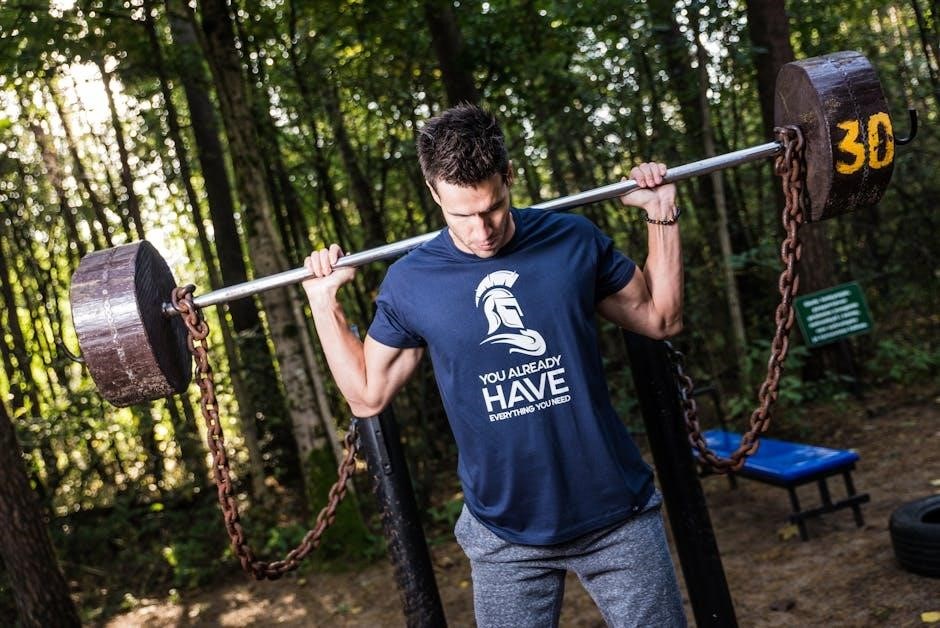
Powerlifting program PDFs are readily available online, notably on Lift Vault. Evaluating quality and customizing the program to individual needs is essential for success.
Lift Vault and Other Resources
Lift Vault stands out as a premier online repository for free powerlifting programs in PDF format, boasting an extensive collection for all experience levels – beginner, intermediate, and advanced. It’s a fantastic starting point for anyone seeking structured training plans.
Beyond Lift Vault, various coaching websites and forums offer downloadable programs, though quality can vary. Progressive Resistance Systems also provides a free 15-week intermediate program. Remember to critically assess the source and the program’s methodology before committing; Searching for “powerlifting program PDF” will yield numerous results, but discernment is key to finding a safe and effective plan.
Evaluating Program Quality
When selecting a powerlifting program PDF, critical evaluation is paramount. A quality program should clearly define progression – how weight, sets, or reps increase over time. Look for plans that address the “big three” – squat, bench press, and deadlift – with appropriate variations.
Beware of programs that promise rapid gains or lack a logical structure. Consider the author’s credentials; experienced coaches generally create more effective plans. Avoid running a beginner program for too long, as plateaus will occur. A good program will also consider individual needs and experience levels, offering modifications when necessary. Prioritize safety and proper technique above all else.
Customizing a PDF Program to Your Needs
Even the best powerlifting program PDF may require customization. Consider your individual weaknesses and strengths. If you struggle with lockout on the bench press, incorporate more board press work. Adjust exercise selection based on available equipment and personal preference.
Don’t be afraid to modify volume or intensity, especially if you’re experiencing excessive fatigue or plateaus. A program is a tool, not a rigid rulebook. Listen to your body and prioritize recovery. Remember that intermediate lifters may need to adjust frequency. Tailoring the program ensures it aligns with your specific goals and maximizes your potential for progress.

Nutrition and Recovery for Powerlifting
Powerlifting demands strategic nutrition, prioritizing macronutrients for muscle repair and growth. Adequate sleep and active recovery are vital complements to any program.

Macronutrient Considerations
Powerlifting nutrition centers around optimizing macronutrient intake to fuel intense training and promote recovery. Protein is paramount, supporting muscle protein synthesis – aim for 1.6-2.2 grams per kilogram of bodyweight daily.
Carbohydrates provide essential energy for workouts; intake should be adjusted based on training volume and intensity, generally ranging from 4-7 grams per kilogram. Don’t neglect fats, crucial for hormone production and overall health, consuming around 0.8-1 gram per kilogram.
Strategic timing of macronutrient consumption—pre- and post-workout—can further enhance performance and recovery. A well-balanced diet, tailored to individual needs and a specific powerlifting program, is key to maximizing results.
Importance of Sleep
Sleep is a foundational pillar of recovery in any powerlifting program, often underestimated yet critically important. During sleep, the body repairs muscle tissue damaged during intense training and replenishes energy stores. Aim for 7-9 hours of quality sleep each night to optimize these restorative processes.
Insufficient sleep elevates cortisol levels, hindering muscle growth and increasing the risk of injury. Prioritize a consistent sleep schedule, create a relaxing bedtime routine, and ensure a dark, quiet sleep environment.
Adequate sleep isn’t merely about quantity; sleep quality matters. It directly impacts hormone regulation, cognitive function, and overall performance within your powerlifting journey.
Active Recovery Strategies
Active recovery is a vital component complementing any powerlifting program, going beyond simply resting. It involves low-intensity activities that promote blood flow and reduce muscle soreness, accelerating recovery without hindering progress.
Examples include light cardio like walking or cycling, dynamic stretching, and foam rolling. These techniques help flush metabolic waste products and improve tissue elasticity. Incorporate active recovery days into your weekly schedule, strategically placed between heavy lifting sessions.
Don’t confuse active recovery with additional training; the goal is to facilitate healing, not induce further fatigue. Prioritizing these strategies will enhance your long-term performance and minimize injury risk.